
August 19, 2026
 How to Choose the Best Synthetic Grass for Your Padel Court:
 The Padel Court Phenomenon Sweeps Australia
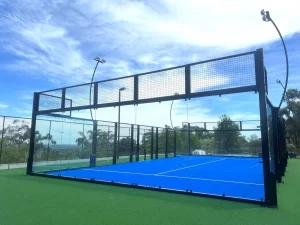
Padel tennis is taking Australia by storm, with commercial hubs in Melbourne and Sydney, and premium private backyards, clamoring to build world-class courts. However, a professional-grade play experience and durability in Australia’s harsh sun is depend on one thing: **the synthetic turf choice.** The wrong turf can lead to uneven ball bounce, high injury risks, and a court that degrades within a few years.
This guide breaks down everything you need to know about specifying padel court turf for your venue or residential project.
1. Textured vs. Straight Monofilament: The Technical Differences**
When shopping for synthetic sports turf, you’ll encounter two structural fiber choices:
**Textured (Curled) Monofilament Turf:** This is the current global gold standard used on the professional World Padel Tour. The fibers are permanently curled during manufacturing. This mechanical texturing securely locks the silica sand infill in place, preventing the sand from shifting or migrating.
The result is uniform ball bounce, superior foot traction, and reduced maintenance.
**Straight Monofilament Turf:** These traditional straight fibers allow for a slightly faster game speed. However, they require more frequent brushing and redistribution of sand infill, as players’ quick lateral movements easily displace the sand.
**The Verdict for Australia:**
**Textured (Curled) Monofilament Turf:** It dramatically lowers your monthly court maintenance and guarantees a high-performance surface that players will book weeks in advance.
2. Pile Height and Density Matter
Padel has strict performance parameters, distinct from standard tennis courts or multi-sport setups:
**The Sweet Spot (10mm to 12mm):** A standard padel turf requires a short, highly dense pile height—ideally 12mm. Anything higher than standard 19mm tennis turf will swallow the ball, slowing the bounce and ruining the fast, explosive rally dynamics of padel.
**Stitch Density:** High-density configurations are key. A denser stitch rate provides structural support to individual blades, keeping them upright even under heavy commercial foot traffic.
3. The Secret to Performance: Premium Silica Sand Infill
No padel court is complete without sand infill. The sand regulates the game’s speed, the ball’s kinetic response off the ground, and player joint safety.
**Volume Requirements:** High-quality 12mm textured padel turf requires 10 to 15 kg of specialized silica sand per square meter.
**The Right Sand:** Use clean, rounded, kiln-dried silica sand. Angular or coarse sand will abrade the synthetic fibers and compact into a concrete-like layer, destroying the court’s drainage capability.
4. Weathering the Australian Climate: UV and Drainage
Outdoor padel courts in Australia need materials built for extreme climates.
**UV Stabilization:** Ensure your turf features robust, heavy-metal-free UV stabilizers engineered for high-UV environments. Imported turf without protection will fade, become brittle, and crack within 24 to 36 months under the Australian sun.
**Rapid Drainage:** Rain shouldn’t stop play for hours. The turf backing must be highly permeable, allowing heavy downpours to drain through immediately to the concrete or asphalt sub-base.
5. Why Partner with Artificial Grass Shop Aust P/L?
At Artificial Grass Shop Aust P/L, we source and supply elite-tier, commercial-grade padel court turf engineered for high-traffic clubs and premium residential setups across Australia. We offer nationwide shipping to Melbourne, Sydney, Brisbane, Adelaide, and beyond.
**Ready to Build?** Contact our expert team today for specific material datasheets, physical product samples, and obligation-free commercial project quotes.